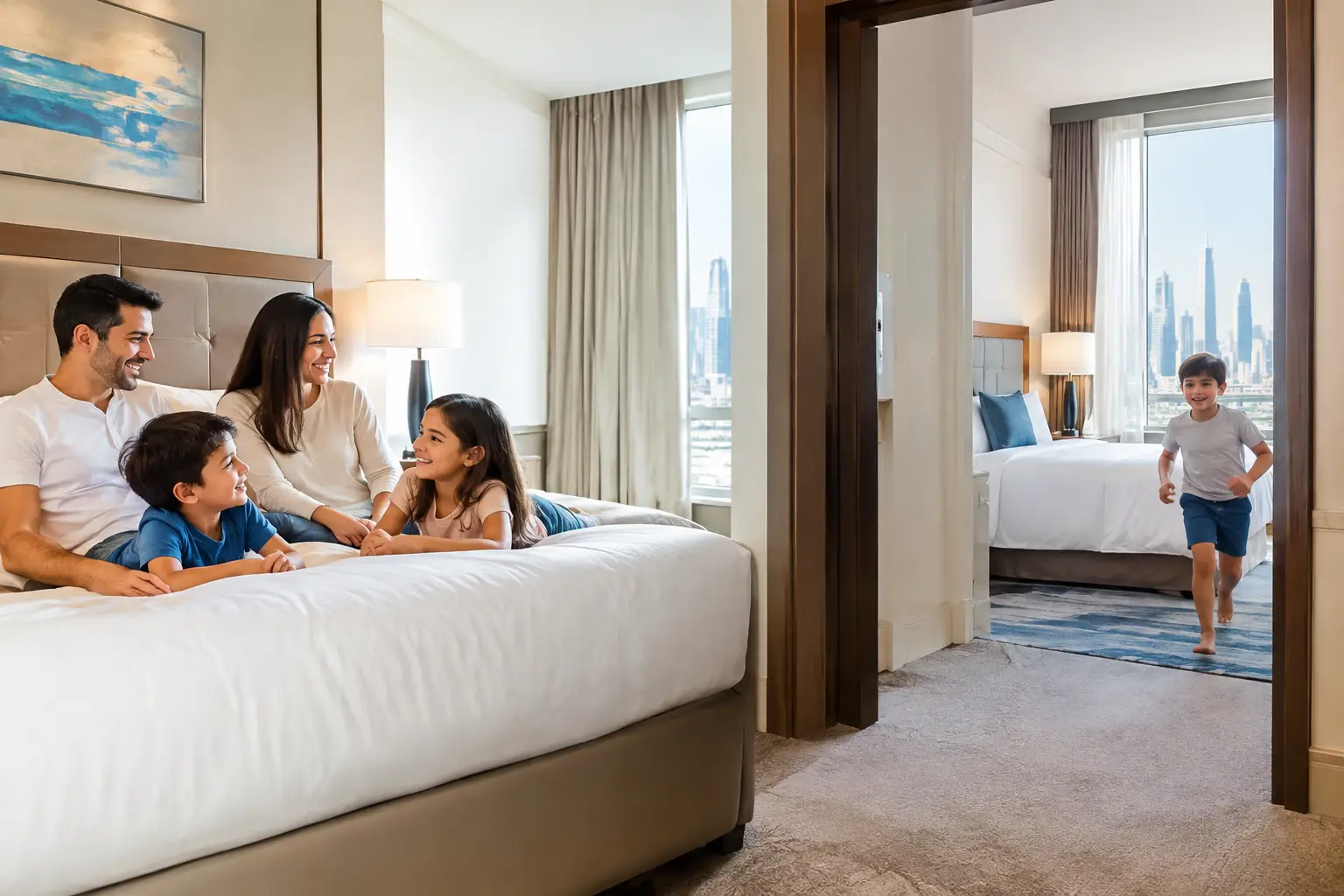
A family trip can feel perfectly planned until bedtime arrives and the hotel has assigned everyone to separate floors. For parents traveling with children, multigenerational groups, or friends who want privacy without distance, the question is simple: which hotels offer connecting rooms and how can you be certain the rooms truly connect before you arrive?
Connecting rooms are one of the most useful hotel features for family travel, yet they are also among the most misunderstood. They are not automatically included with two-room bookings, and a request shown online is not always a confirmed guarantee. The right approach is to choose the right hotel type, understand the room language, and have the request checked directly with the property.
Which hotels offer connecting rooms most often?
Connecting rooms are most commonly found at larger full-service hotels, family resorts, upscale city properties, airport hotels, and all-suite accommodations. These hotels typically have a wider range of room layouts, larger inventories, and experience managing family and group requests.
International hotels in major destinations are often a strong starting point, particularly properties designed for leisure travelers or business groups. Resorts may offer connected standard rooms, adjoining villas, or linked family suites. City hotels may pair two standard rooms, a room and a suite, or rooms in a dedicated family configuration. Airport hotels can also be practical for families with early departures or overnight stopovers, although availability may be tighter during busy travel periods.
Smaller boutique hotels, historic properties, and compact urban hotels can be charming choices, but they may have few or no connecting-room pairs. Their buildings may have been converted from older residences, which can limit the layout. If connected rooms are essential, it is wise to treat these properties as a preference rather than the first choice.
The most reliable options tend to be hotels that actively welcome families, have multiple room categories, and clearly mention family rooms, interconnecting rooms, adjoining rooms, or two-bedroom suites in their accommodation details. Still, wording matters.
Connecting rooms, adjoining rooms, and suites are not the same
A connecting room means two separate guestrooms with an internal door between them. Each room generally has its own entrance from the hallway and its own bathroom. Parents can close the hallway doors, use the inner door to move between rooms, and keep children nearby while maintaining separate sleeping spaces.
An adjoining room usually means two rooms located next to each other, but there may not be an internal door. This setup can be convenient, especially for older children or adult relatives, but it does not provide the same level of access or supervision.
A family room is another term that needs clarification. At some hotels, it means one larger room with extra beds, bunk beds, or a sofa bed. At others, it may be two rooms linked by an internal door. A two-bedroom suite can offer even more space, with bedrooms connected through a shared living area, but it may cost more than two standard connecting rooms.
For families, the best value depends on the trip. Two connecting standard rooms can provide two bathrooms and more sleeping flexibility. A suite can be more comfortable for longer stays, particularly when a separate living room makes afternoons and early bedtimes easier. For grandparents traveling with the family, two connecting rooms may create the right balance of closeness and independence.
How to find the right hotel before you book
Start with the destination, travel dates, number of guests, and ages of children. This information affects which room combinations the hotel can legally and comfortably provide. A request for two adults and two young children may be handled differently from a request for four adults, two teenagers, and an infant.
When reviewing a hotel, look beyond the main room photo. Check whether the property offers several room types, family accommodations, suites, or rooms with multiple bedding layouts. A hotel with only one room category may not have enough inventory to create a connecting pair.
It also helps to consider the practical rhythm of your stay. At a beach resort, proximity to the pool, restaurant, kids’ activities, and elevators may matter as much as the rooms themselves. In a city hotel, you may prefer a quiet floor, easy elevator access for strollers, and a location close to the attractions on your itinerary. The hotel should support the whole journey, not simply provide a place to sleep.
Ask for a confirmed connecting-room request
The most effective wording is specific: request “two connecting rooms with an internal door” and include the guest count and children’s ages. Avoid relying only on phrases such as “rooms close together” or “family accommodation.” They can be interpreted differently by each property.
Because connecting rooms are often limited, hotels usually assign them based on availability at check-in or closer to arrival. A reservation note is valuable, but it is not identical to a confirmed room feature. Ask whether the hotel can confirm the connecting configuration in advance and request written confirmation whenever possible.
If the rooms cannot be guaranteed, ask about alternatives. A two-bedroom suite, a family room with a partition, or two neighboring rooms on the same floor may be suitable depending on the ages of the travelers and your comfort level.
When should you book connecting rooms?
Book as early as possible, especially for school breaks, holiday travel, major events, and popular resort seasons. Hotels may have many standard rooms available while only a small number are physically configured as connecting pairs. Waiting until the final days before departure can limit choices, even when the hotel still appears available online.
Early booking is particularly helpful for UAE residents traveling during peak summer holidays, winter escapes, long weekends, and family celebrations abroad. It gives more time to coordinate special requests alongside flights, transfers, visas where required, and activities suited to every age group.
After booking, reconfirm the request before travel. A short check closer to arrival can catch changes in guest numbers, room categories, or hotel inventory. If you are arriving late at night, mention this as well. A property that understands your arrival time can better prepare for a smooth check-in after a long flight.
Questions worth asking the hotel
Before finalizing a booking, ask whether the rooms have a true internal connecting door, whether both rooms have separate bathrooms, and whether the arrangement can be noted or confirmed on the reservation. It is also useful to ask about bed configurations, cribs, extra beds, balcony access, and whether the connecting rooms are in the same category.
For families with younger children, confirm that all guests can be assigned to the intended rooms under the hotel’s occupancy and safety policy. For larger families, ask whether the property has a two-bedroom suite or a combination of connecting rooms that can accommodate everyone without splitting the group across the hotel.
Accessibility deserves attention too. If someone in your group uses a wheelchair, has limited mobility, or needs a step-free shower, check whether accessible rooms can connect to another guest room. This configuration is less common, so it should be requested early.
A smoother way to coordinate a family stay
Hotel room planning becomes much easier when it is coordinated alongside the rest of the trip. Your flight time may affect whether an airport hotel is useful. Your sightseeing schedule may make a central city property more practical. A resort may be the better choice when the goal is unhurried family time, children’s activities, and space to relax between excursions.
Copa Cabana Tourism can help travelers compare suitable room configurations, communicate the connecting-room request clearly, and coordinate accommodation with transfers, tours, restaurant reservations, and other trip details. The goal is not simply to reserve two rooms. It is to arrange a stay that works comfortably from arrival through departure.
A connecting-room request is a small detail with a major impact on how relaxed a family holiday feels. Share your group’s needs early, ask for the exact layout you want, and keep a flexible alternative in mind. That preparation leaves more room for the moments that matter: slow breakfasts, easier bedtimes, and the freedom to experience your destination together.